
Dead Companies
The biggest business failures, told from the moment they fell.
Watch on YouTubeThe stories so far
Every full story, newest first. Each one opens on YouTube.

Pan Am Owned the Sky. One Rule Killed It
Pan Am launched the jet age, ordered the first 25 Boeing 747s for $525 million, and was the most famous airline on Earth. Then it spent a decade selling everything it owned to stay alive. On December 4, 1991, its last flight landed in Miami. The bomb over Lockerbie didn't kill Pan Am. A rule written in 1927 did.

Nokia Built a Touchscreen Phone in 2004, Then Killed It
In 2007 Nokia sold 4 out of every 10 phones on Earth and more than half of all smartphones. Six years later its phone business was sold to Microsoft for $7.2 billion, and two years after that Microsoft wrote almost all of it off. Nokia had a touchscreen phone with an app store in 2004. This is why it never shipped.

MySpace Wasn't Killed by Facebook. It Was a $900M Deal
In 2006 MySpace was the most visited website in America, bigger than Google, with 100 million accounts. Five years later it sold for $35 million, a 94% loss for News Corp. Facebook didn't kill it. A $900 million Google deal did, and almost nobody noticed at the time.

Lehman Didn't Die From Subprime. This Is What Killed It
In 2007 Lehman Brothers made a record $4.2 billion profit and its CEO was paid $22 million. Twelve months later it filed the largest bankruptcy in history, with $639 billion in assets and 25,000 employees. Everyone blames subprime mortgages. The real killer was $31 borrowed for every $1 it owned, and one bet made at the very top of the market.

Circuit City Fired Its Best Salespeople, Then Died in a Year
On March 28, 2007, Circuit City fired 3,400 of its best-paid salespeople in a single day to save money. Twenty months later, the 12-billion-dollar electronics chain that a bestselling business book called great was bankrupt, and 34,000 people were out of work. This is how a company that was studied as a model of greatness managed to kill itself.

Borders Handed Its Website to Amazon, Then Died
In 2001, the second-largest bookstore chain in America handed its entire online business to Amazon and said thank you. Borders had 1,249 stores and 4 billion dollars a year in sales. Ten years later it owed 1.29 billion dollars and 10,700 people lost their jobs in a single summer. This is how a bookstore paid its killer to run the store.

BlackBerry Didn't Lose to the iPhone. It Lost Its Customer
In early 2010, 43% of American smartphone owners carried a BlackBerry. By 2016 its global share was zero. It had touchscreens, it had the President, and it had nearly 20 billion dollars a year in revenue. This is why none of that mattered once employees stopped asking the IT department for permission.
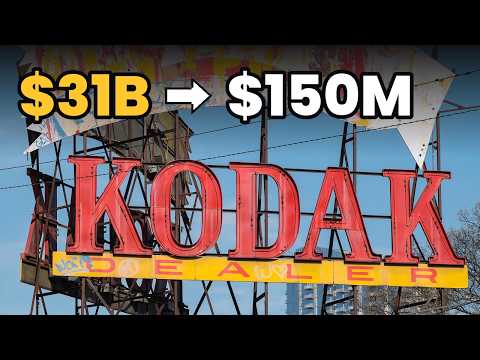
Kodak Invented the Digital Camera, Then Hid It
In 1975, a 24-year-old Kodak engineer built the world's first digital camera. His bosses told him to hide it. Kodak owned 90% of the film market, employed 145,000 people, and still went bankrupt. This is how the company that invented the future refused to sell it.
What this is
Big companies that crashed and burned, and the one decision that sank each of them. Kodak, Pan Am, Nokia, MySpace: every week a new giant, told from the moment it fell.
Narration is an AI voice. Real photos are credited in each video's description; other images are AI-generated illustrations.